
Understanding the Army Combat Fitness Test (ACFT)
Introduction to the ACFT
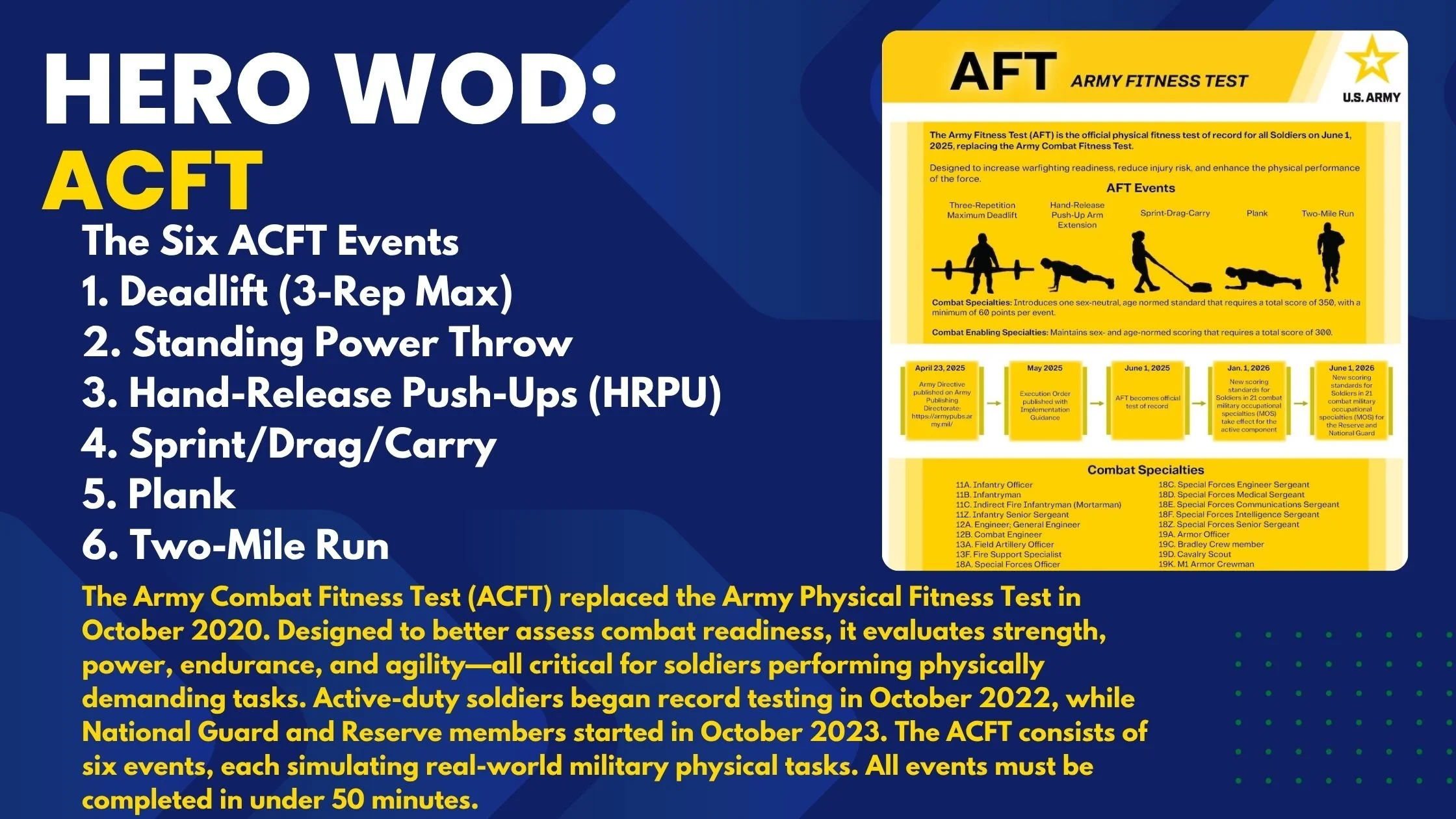
The Army Combat Fitness Test (ACFT) replaced the Army Physical Fitness Test in October 2020. Designed to better assess combat readiness, it evaluates strength, power, endurance, and agility… all critical for soldiers performing physically demanding tasks.
Active-duty soldiers began record testing in October 2022, while National Guard and Reserve members started in October 2023. The ACFT consists of six events, each simulating real-world military physical tasks. All events must be completed in under 50 minutes.
The Six ACFT Events
1. Deadlift (3-Rep Max)
Purpose: Replicates lifting ammunition boxes, equipment, or a wounded soldier.
Structure: 15 minutes to find your 3-rep max.
Tips: Warm up properly, focus on hip and core drive, maintain bar close to the body, and use controlled form to avoid injury.
2. Standing Power Throw
Purpose: Measures explosive power needed to lift or move yourself or objects over obstacles.
Structure: 5 minutes to toss a 10-lb slam ball as far as possible.
Video Reference:Standing Power Throw Demonstration
Tips: Use hips and legs explosively, maintain core stability, and follow through for maximum distance.
3. Hand-Release Push-Ups (HRPU)
Purpose: Tests upper body strength and endurance, simulating pushing or moving objects.
Structure: Perform as many HRPUs as possible in 2 minutes within a 5-minute window.
Technique: Lower chest to the floor, lift hands briefly, reset, and repeat.
4. Sprint/Drag/Carry
Purpose: Simulates battlefield mobility, moving quickly to cover, or transporting equipment or a fellow soldier.
Structure: Complete a 25-m course in this order:
Sprint
Drag a 90-lb sled
Side shuffle
Farmer’s carry with two 44-lb kettlebells
Sprint
Video Reference: Sprint/Drag/Carry Demonstration
Tips: Pace your energy, maintain proper technique for sled drag, shuffle efficiently, and avoid gripping kettlebells too tightly.
5. Plank
Purpose: Measures core stability, replacing the leg tuck, which can disadvantage those with less upper-body strength.
Structure: Maintain a proper plank position for as long as possible within a 5-minute window.
Tips: Keep a straight line from head to heels, engage glutes and core, and avoid sagging hips.
6. Two-Mile Run
Purpose: Assesses cardiovascular endurance.
Structure: Complete a 2-mile timed run within the remaining time.
Tips: Warm-up with light jogging and strides, maintain even pacing, and focus on breathing technique.
ACFT Strategy Tips
Time Management: Move to the next event as soon as you finish—no need to wait for the full window.
Energy Distribution: Conserve energy during early events to maintain strength and speed for later exercises.
Form First: Prioritize proper technique to avoid injury, even when aiming for maximum repetitions or weight.
Simulation Training: Practice events in sequence to get accustomed to fatigue and transitions.
Recovery: Hydrate well before the test and include dynamic stretches between events.