
Hero WOD Patton: Pace, Purpose, and Grit
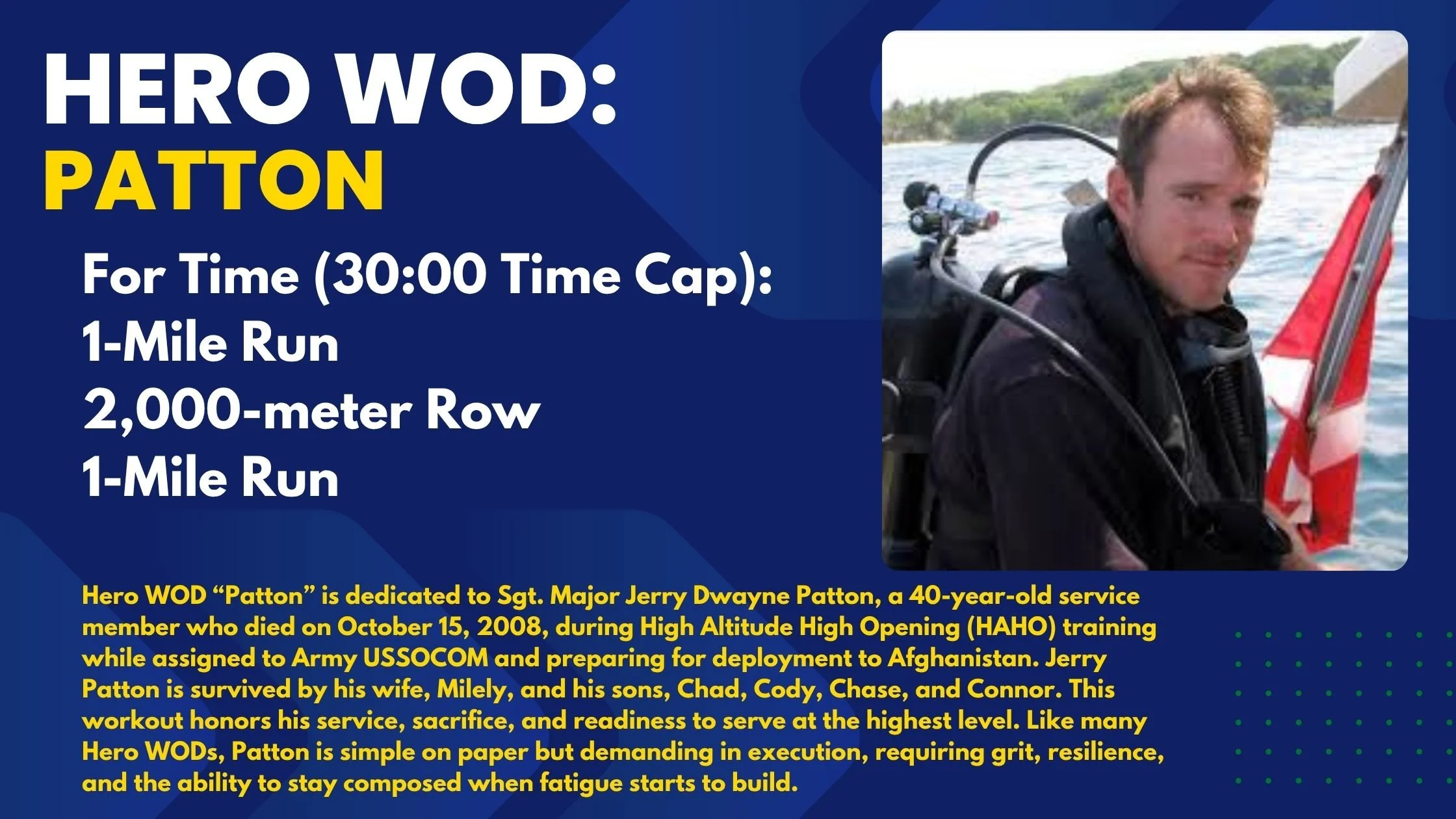
Honoring Sgt. Major Jerry Dwayne Patton
Hero WOD “Patton” is dedicated to Sgt. Major Jerry Dwayne Patton, a 40-year-old service member who died on October 15, 2008, during High Altitude High Opening (HAHO) training while assigned to Army USSOCOM and preparing for deployment to Afghanistan.
Jerry Patton is survived by his wife, Milely, and his sons, Chad, Cody, Chase, and Connor.
This workout honors his service, sacrifice, and readiness to serve at the highest level.
Like many Hero WODs, Patton is simple on paper but demanding in execution, requiring grit, resilience, and the ability to stay composed when fatigue starts to build.
The Workout: Hero WOD “Patton”
For Time (30:00 Time Cap):
1-Mile Run
2,000-meter Row
1-Mile Run
Workout Variations
RX (As Prescribed)
1-Mile Run
2,000-meter Row
1-Mile Run
Intermediate (Scaled)
800-meter Run
1,500-meter Row
800-meter Run
Beginner (Accessible)
Complete with a partner, split as desired
1-Mile Run
2,000-meter Row
1-Mile Run
Training Advice
Warm-Up Recommendations
5–8 minutes of easy cardio
Easy jog and light rowing to elevate heart rate
Dynamic leg swings, walking lunges, and calf mobility
Practice building pace on short 200-meter runs
Row 2–3 short intervals focusing on smooth stroke mechanics
Movement Standards & Form Cues
Run
Maintain a tall posture with relaxed shoulders
Keep hands loose and avoid excessive tension
Use short, quick strides rather than overreaching
Stay aware of pacing, especially in the opening mile
Row
Drive with the legs first, then hips, then arms
Keep the stroke smooth and controlled
Avoid rushing the recovery back to the catch
Monitor stroke rate so effort stays sustainable
Mindset Preparation
This workout is an endurance test disguised as a simple triplet.
The challenge is not just finishing. The challenge is pacing it well enough to finish strong.
Athletes who come out too fast on the first mile often spend the rest of the workout trying to recover.
The goal is to stay patient early, stay mentally engaged in the middle, and compete on the final mile.
Performance Strategy
Rep Breakdown
This workout is best broken down by section rather than reps
First mile: controlled effort
Row: smooth and sustainable
Final mile: strong finish
A helpful benchmark is to aim to complete each section in about 10 minutes
Pacing Plan
Avoid starting the first mile at a sprint pace you cannot sustain
If running is your strength, use the rower for recovery
If rowing is your strength, stay patient on the runs and make up time on the row without redlining
Save enough energy to increase your pace on the final mile
Key Insight: Endurance Discipline
The real test in Patton is not whether you can survive discomfort. It is whether you can pace with discipline. We want athletes learning how to move faster when tired, not just hanging on and slowing down. Strong execution means giving yourself the chance to finish the second run with intent instead of just surviving it.
For coaches, this workout is a great opportunity to provide focused, actionable feedback throughout the piece. Instead of only cheering, focus on a few measurable items like head and arm position during the run, stroke rate on the rower, and 400-meter or 800-meter pacing during the runs.
Recovery & Hydration
Walk for a few minutes after finishing to bring the heart rate down gradually
Hydrate with water or electrolytes after the workout
Refuel with protein and carbohydrates
Stretch calves, hamstrings, hip flexors, and lats post-workout